


|
Listen to this article now
Getting your Trinity Audio player ready...
|
Cumbres de Abona plans to reach the 200.000 kilos of olives in 2026 and reinforce the production of its Oleoteide EVOO in Tenerife
The olive campaign advances in Tenerife with good prospects for Abona Summits, one of the cooperatives that paved the way for this crop in the Canary Islands and that this year plans to reach the 200.000 kilos of olive.
The figure would represent a jump compared to last season, when his oil mill processed around 150.000 kilos and obtained about 32.000 liters of extra virgin olive oil.
The harvest started last 17 August and, to date, the cooperative has already collected around 100.000 kilos. As explained by its president, Manolo Marrero, The rains recorded during the year allow us to foresee a particularly favorable production.
Approximately a 15% of the olives collected will go to Oleoteide, the brand under which Cumbres de Abona markets its extra virgin olive oils.
More than two decades betting on the olive tree
The olive growing history of the cooperative began in the year 2000, when he decided to introduce olive cultivation within an agricultural diversification strategy.
A decade later it incorporated its own grinding line and began working on varieties such as arbequina, arbosana, coronaiki and picual.
The cooperative itself places in 2005 the elaboration of what he considers first commercial olive oil produced in the Canary Islands. Since then, claims to have distributed more than 300.000 olive tree seedlings in Tenerife, El Hierro and La Palma, thus contributing to the spread of a crop that just a few decades ago had a very reduced presence in the Archipelago..
Currently, Oleoteide EVOOs have accumulated nearly thirty recognitions in national and international competitions since 2015. Among the most recent is the silver medal achieved this year in the Official Agrocanarias Competition by an oil made with arbequina and picual.
From olives to EVOO
The production is carried out using a continuous two-phase line..
After grinding, The olive paste goes through the blending process and then through a decanter that separates the oil based on the different densities.. The process is carried out through cold extraction, with the aim of preserving its aromatic and gustatory characteristics.
Oleoteide oils present, according to the description of the cooperative, a profile of green fruity, with notes reminiscent of tomato and green banana, plus green almond, aromatic herbs and nuts.
The production also has a quick release to the market. Marrero points out that oils usually run out two or three months after marketing, a fact that explains the cooperative's interest in maintaining this line within its diversification strategy.
A cooperative that no longer lives only on wine
Cumbres de Abona was born in 1988 closely linked to viticulture and continues to produce wines under the brands Abona Summits, Flower of Chasna and Testament.
It currently brings together more than 800 partners of the Abona region and its facilities occupy around 200.000 Square meters.
In recent years it has also incorporated the pistachio as a new crop and has begun to develop oleotourism proposals that allow us to learn about both the production of oil and the agricultural landscape of the area..
The visits include the old oil mill installed in Tenerife and later donated to the cooperative by Cajasiete, the jable caves and tastings of their wines and oils, thus expanding productive activity towards experiences linked to gastronomy and the territory.
The olive grove, a crop still small but growing
The development of Cumbres de Abona also reflects the progressive implementation of the olive tree in the Canary Islands.
The regional administration currently maintains specific lines to support oil mills and cultivation.. These include aid from 51.875 euros for the oil mills of the Archipelago, in addition to 204.279 euros granted during two campaigns as extraordinary support to the olive grove against the effects of the drought.
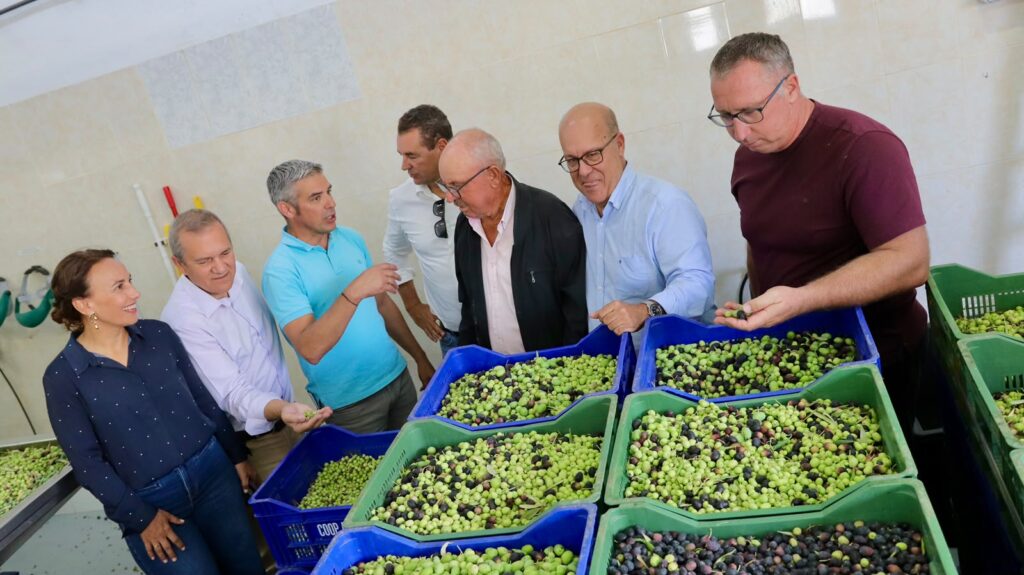
The Minister of Agriculture of the Government of the Canary Islands, Narvay Quintero, This week he visited the cooperative's facilities in Arico to learn about the evolution of the campaign and the operation of the oil mill..
Beyond that visit, Own harvest data offers a more meaningful picture: of the 150.000 kilos processed last year at a forecast of 200.000 in 2026, in a cooperative that began experimenting with the olive tree more than a quarter of a century ago.

