


|
Listen to this article now
Getting your Trinity Audio player ready...
|
The most of 50 rural chefs participating in Terrae 2025 They prepare a document in which they claim rural cuisine as cultural heritage
“Rural cuisine is much more than a way of eating: It is a living expression of culture, a language of flavors, memories and territory. Through recipes passed down from generation to generation, rural gastronomy connects knowledge of the natural environment with sustainable and deeply human ways of life”.
In this context, a group with more than 50 cooks from the rural world of Spain, Portugal, Italy and Colombia have drafted the Agüimes Declaration, a manifesto that advocates for the recognition, protection and support of rural cuisine as cultural heritage. In the document, prepared during the third edition of Terrae that was held in 23 al 25 March in Gran Canaria and presented at the closing dinner held at the La Pasadilla de Ingenio restaurant (Gran Canaria) by the director of the congress Benjamin Wool and the mayor of rural cooks Luis Alberto Lera, A call is made to public institutions to give rural gastronomy support similar to that received by other cultural expressions such as cinema or music.. The Agüimes Declaration was born with a desire for continuity, since the document will serve as a basis to continue working together for the future of rural cuisine.
The declaration highlights the need to ensure decent wages and attractive working conditions to attract and retain talent in rural settings. Besides, underlines the importance of promoting egalitarian and participatory work environments that allow people to develop their life projects in these territories. In addition, one of the commitments acquired is to “strengthen ties with local communities, involving villagers in gastronomic projects, prioritizing local talent and giving visibility to nearby producers”. For this, Specific regulations are demanded to facilitate commercial exchanges between small producers and rural restaurants., promoting the preservation of native products at risk of disappearance.
Besides, The chefs who support the Agüimes Declaration commit to developing their own rural identity, promoting the diversity of culinary cultures and raising awareness among institutions about the importance of their involvement in the protection of rural cuisine. Finally, highlights the study project to “promote the Terrae brand as a badge for restaurants and producers that defend committed gastronomy rooted in the territory.”, in order to strengthen the rural cuisine movement and its impact on the local economy”.
With this statement, professionals in the sector reaffirm their commitment to a sustainable future rooted in the culinary traditions of the people, ensuring that rural gastronomy continues to be a fundamental pillar of cultural identity.
This document has been prepared during the third Rural Gastronomy Meeting in which more than 50 chefs coming from various Spanish regions, encompassing all the 17 autonomous communities. There has even been the presence of international rural chefs from Portugal., Italy and Colombia, whose representative Leonor Espinosa was also awarded the Terrae award during the congress for her commitment to the indigenous communities of her country and the preservation of their culture..
Meet the producer first hand
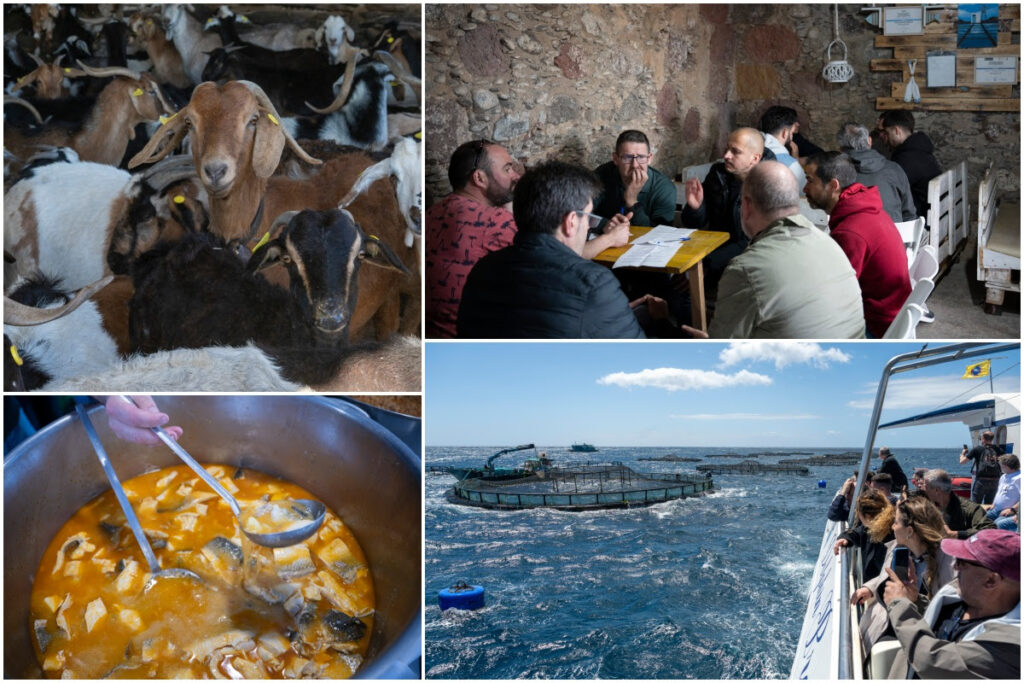
Beyond the presentation of the Agüimes Declaration, the last day of Terrae 2025 It was also a day in which artisanal and quality products were valued.. The morning started with a visit to one of the largest goat herds in Gran Canaria., It is about more than 1.500 native Canarian breed goats that they manage Jose Miguel Ortega and his wife Paqui Perez at the La Gloria farmhouse (Saint Augustine). This family tradition cheese factory produces between 2.000 y 2.200 liters of milk per day with which it produces 270 kilos of artisanal cheese daily. Ortega assures that there is no more secret to a good cheese than quality milk, and this is helped by the fact that “the cattle graze freely on the stony slopes of Amurga with an almost constant temperature softened by the proximity of the sea”.
And from inland to sea, since the expedition also ventured into the open sea to be able to see up close the work that the large Atlantic sea bass breeding company Aquanaria carries out in the sea bass farms it has installed off the Canary coast.. Arancha Pesteguía, marketing manager of Aquanaria, accompanied the congressmen on the journey aboard the Princesa Ico catamaran, providing various details about the breeding of this fish that “grows in nurseries two miles from the coast and with very low culture density, 98% water, 2% of fish; which allows the bass to have a lot of mobility”.
The taste of the product in practice
The sensory part of the visits that took place during the day on Tuesday of this third Terrae also had its translation at the table. After being able to taste several of the cheeses made in La Gloria, The guests of this edition enjoyed a lunch at sea offered by local chefs Nelson Pérez , from Nelson restaurant (Agüimes) y Marina Tudanca & Alejandro Sosa, in charge of the Maraca restaurant (The Palms). On deck, several dishes could be savored with sea bass as the protagonist., as is the case of the sea bass tiradito with jalapenos dressing and fried mini anchovies; the blanched sea bass and gofio broth, or the fresh jarea de lubina. There was no shortage of traditional stews either., like choco's old clothes.
The end of the gastronomic festival of the third edition of Terrae took place at the La Pasadilla grill (Wit), that for a day he soaked up the Leonese flavor when receiving Jose Gordon, from the temple of meat El Capricho (Jimenez de Jamuz). Gordon and Carmelo Gonzalez, La Pasaadilla chef, They offered a product festival in which they could taste the exclusive pieces of beef from the former's livestock in various preparations., like a roast beef of roasted picaña with pickled red cabbage, a hip steak tartare with brioche bread or an artisanal blood sausage from León that is 100% beef.

