


|
Listen to this article now
Getting your Trinity Audio player ready...
|
With capacity for 30.000 liters, the winery adds underwater wine, wine tourism and oil to your project in the Güímar Valley
El Rebusco Bodegas has found in diversification a way to grow without losing sight of the vineyard. From the Güímar Valley, the project led by Javier Luaces and Deborah Díaz combines wine making, wine tourism experiences, underwater aging and, since this year, a new line of extra virgin olive oil.
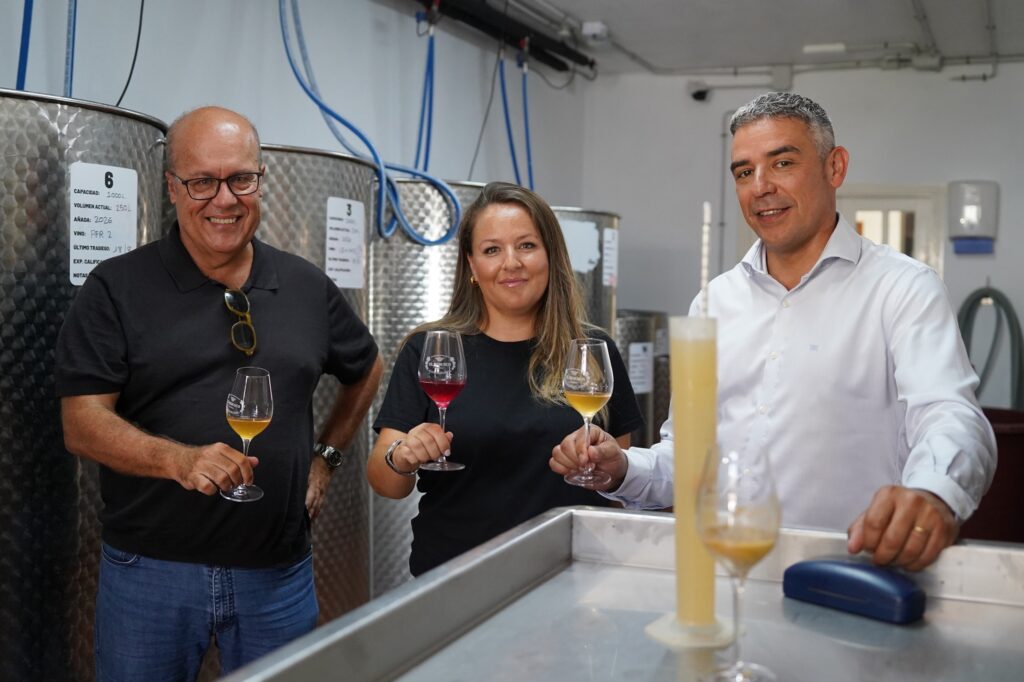
The winery is currently going through a new harvest and currently has facilities capable of producing around 30.000 liters of white wines, rosés and reds, made mainly with grapes from their own farms. The Minister of Agriculture has known him first-hand, Cattle raising, Fisheries and Food Sovereignty of the Government of the Canary Islands, Narvay Quintero and the CEO of the public company Gestión del Medio Rural de Canarias (GMR Canarias), Juan Antonio Alonso. They explained that part of the raw material is also purchased from other winegrowers in the region..
Their wines are protected by the Güímar Valley Protected Designation of Origin and find their main market in Tenerife. The firm has chosen to market them directly in specialized establishments and selected restaurants, dispensing with distributors to maintain closer contact with its customers. Approximately a 10% of the production travels to other islands and the Peninsula.
Wines that also rest under the Atlantic
Among the initiatives that distinguish El Rebusco is its underwater winery, considered by its managers to be the first permanent modular facility in the Canary Islands for the control and aging of wines under the sea.
It has capacity for about 5.000 bottles and is located 18 meters deep. There the wines remain subject to particular temperature conditions., humidity, pressure, absence of light and movement caused by the tides. The winery maintains that this environment influences the evolution of the productions, especially in its aromatic expression and texture.
Es, probably, the most striking face of a project that began long before.
The El Rebusco brand was born in 2010 as a continuation of a family agricultural tradition linked to farms in the high areas of Arafo and the midlands of Candelaria. The incorporation of Luaces and Díaz in 2020 marked the beginning of a stage of modernization, with new machinery, expansion of the facilities and a more determined orientation towards wine production and the dissemination of the wine culture of the region.
Both are senior technicians in Viticulture trained at the Tacoronte Agrarian Training School., a profile that contributes to the project one of the elements that currently most concerns the Canarian countryside: the generational change.
The winery as a place to go
The wine, however, It is only part of the approach. El Rebusco has also developed a program linked to wine tourism, with tasting workshops, gastronomic days dedicated to local products, activities linked to traditional celebrations and dramatized routes.
In recent years, its facilities have received visitors from more than 30 countries.
This aspect of the business earned him 2024 the Enogastroturismo Award for Business Initiative, awarded by the Chair of Agrotourism and Wine Tourism of the Canary Islands Institute of Agri-Food Quality and the University of La Laguna. The recognition placed special emphasis on the recovery and revitalization of the agricultural farms of Arafo and Candelaria.
From wine to oil
The last leg of that diversification has come from another crop. At the beginning of 2026 The company brought to the market its first extra virgin olive oil.
Production exhausted its stocks in just four months, according to the information provided by the winery itself, and the intention of those responsible is to maintain this line in future campaigns.
El Rebusco thus draws a model of a small wine company that tries to expand the value of the grape beyond the bottle.: produce wine, sell it directly, generate experiences around the vineyard and take advantage of other agricultural possibilities in the territory. A path in which family tradition, training and a certain willingness to experiment—even 18 meters under the sea—they end up sharing a project.

