


|
Listen to this article now
Getting your Trinity Audio player ready...
|
The first mention of its cultivation on island soil dates back to 1537 in Gran Canaria, but it was from the 19th century onwards that it began to reach a peak in the Archipelago
Who has not ever lived in a restaurant?, restaurant or similar that moment when the waiter approaches the table to recite the contents of the menu and when he reaches a certain dish he underlines, also with emphasis, that its ingredients include onion Guayonje. Its simple pronunciation already sounds sweet to the ear and represents in itself a plus of quality., an added value and a claim capable of seducing and awakening the curiosity of even the most demanding diner.
The truth is that on a good number of occasions this is a gross fallacy., a bad practice because such a variety is not usually served, but an alternative, In addition to the fact that in certain months of the year this type is not present on the market, which undoubtedly represents a deception to the consumer, to the customer - not to mention the resulting overcharge -, from whom the true qualities of this modest vegetable but with a unique flavor and present in the history of Canarian agriculture are stolen..
Between Tacoronte and Gáldar passing through Arrecife
On purpose, It also draws powerful attention that, being the onion Guayonje a product so mythologized and idolized at a gastronomic level, at the same time rooted in the popular imagination - many people's mouths are filled with his name -, he Tacoronte City Council It has taken years and years to stage the importance of one of its main agricultural icons, to the point that it was last June, and it has already rained, when he finally decided to organize the first Guayonje Onion Tapa Route, an action that, however, does not guarantee its continuity in the future.
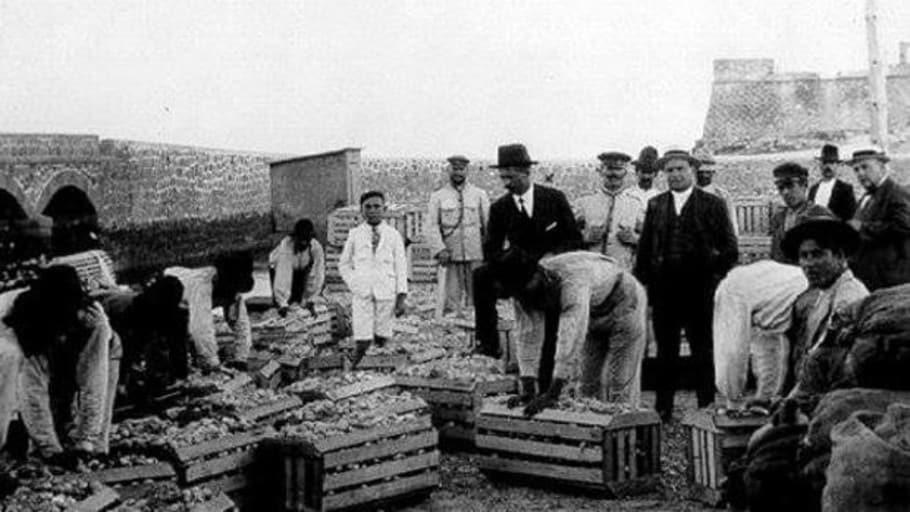
The same can be said of the city of Reef, the capital of Lanzarote, whose councilors also seem to have suffered historical amnesia. By June 2020, being mayor Astrid Perez, was announced I Festival and Technical Onion Conferences. They were going to be developed in the park located next to the one that was La Onion Pier, a place name that is not the product of chance and that comes to point out the importance that the appreciated dryland rabbitry vegetable represented as an export product destined for, above all, to the markets of the Peninsula and the north of Europa.
It was that one La Onion Pier or small dock, inaugurated on 29 June of 1792, the platform that served as the basis for maritime trade Reef well into the 20th century. But between the pandemic and municipal apathy, the tribute to the onion Lanzarote came to nothing.
Following in the Volcano Island, the Villa de Teguise, as part of the fair Our Flavors, in 2017 paid tribute to the onion by depicting how its leaves are cut and then peeled off the orange skin, leaving it ready for its various uses in the kitchen. The public tasted a gofio scald served with smoked mojos and onion flakes turned into ladles., plus a montadito of creamy goat cheese and palm honey with caramelized onion, as well as an onion tart.
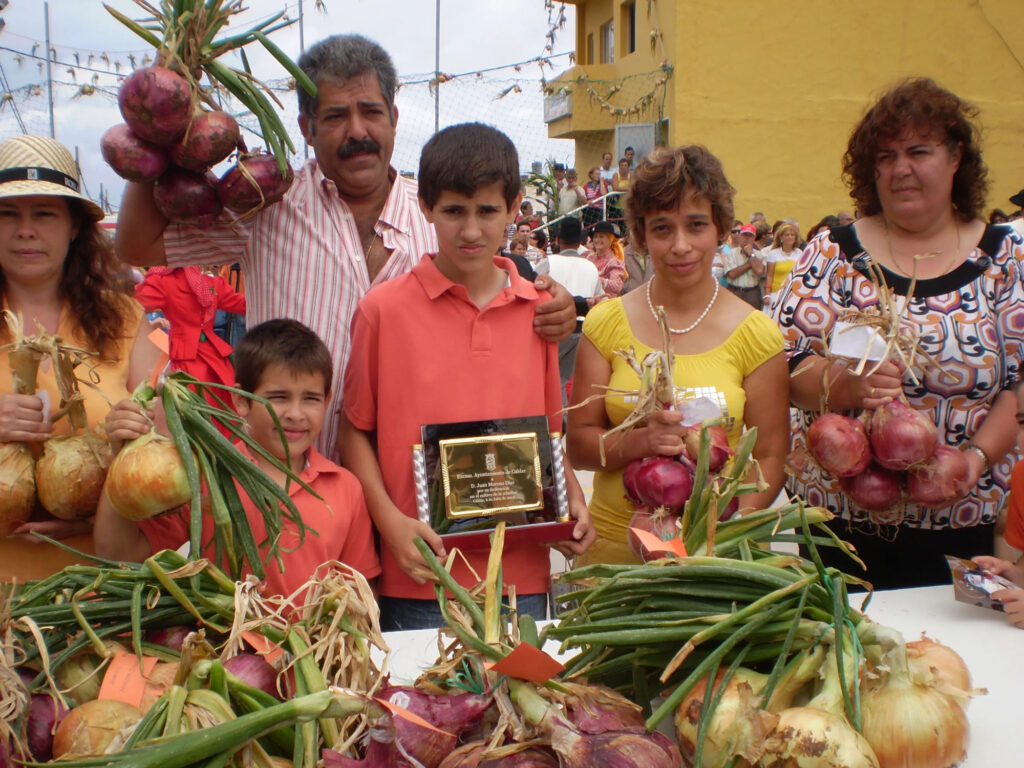
In the opposite groove, the Gran Canaria City Council of Galdar has demonstrated a greater commitment over time to this exponent of its agricultural heritage. So, In a plenary session held last May, it was unanimously agreed to initiate the file to patent the brand. Gáldar onion, thus guaranteeing, with the approval of the European authorities, its origin and identity and promoting the unique and differentiated quality of this historic product of the municipality. Precisely, this sunday, 7 of July, the Onion Festival is celebrating its anniversary with the celebration of its XXV edition, and the opportunity will be taken to constitute the Gáldar Onion Producers Association.
He Cabildo of Gran Canaria, for his part, presented in 2019 the book 'The Onion of Gáldar: tradition and science, a journey through the history of this product that began to be cultivated for export at the end of the 19th century, and in which varieties are analyzed, characteristics, nutritional and medicinal properties, in addition to collecting the knowledge of farmers and their efforts to perpetuate the seeds. This crop has been so popular in that area that the Galdenses are popularly known by the name of onions..
The origins of the onion in the Canary Islands
It is fully accepted that the onion (Garlic onion L.) has its origin in the field of Asia Central ago more than 8.000 years, Although the great expansion by Europa did not take place until Middle Ages. There is no evidence of its cultivation on the islands during pre-Hispanic times and it is deduced that the conquerors must have introduced it.. The first mention of its cultivation on island soil dates back to 1537 in Gran Canaria, but it was from the 19th century onwards that it began to reach a peak in the Archipelago, beginning its export to Cuba and other areas of the New Continent. At the end of that century, the shipment of onions to the American market stood out., while the seeds headed towards England, probably from its ports to travel to the British overseas colonies. At that time, The onion became a staple crop for the economy of the English colonies..
In an article published in the magazine Pellagofio of the 7 February 2024, titled 'The onion and the sauce, pillars of Canarian gastronomy’, the professor Luis Serra highlights that in Canary Islands, with an annual production of almost 9.000 tons, “Onion not only has economic relevance, but also cultural”, pointing out that local varieties are adapted to the microclimate and are essential in the island's gastronomic identity. In this sense it refers to its presence in gofio escaldones, as well as in many dishes in which it is the main ingredient. “There are the typical stir-fries and fish recipes with Portuguese influence., the encebollados in which cod is used, the cherne or the stoker”, comment.
Varieties and applications in Canarian cuisine
The variety Sardine, dark purple and slightly flattened, Due to its medium spicy flavor, it is usually used to accompany kneaded or escaldón gofio.. For your part, the variety Roja, much less spicy, It is used more to eat raw in salads.
Tenerife also exhibits the diversity of this crop. According to the CCBAT (Tenerife Agricultural Biodiversity Conservation Center), The island has some local varieties of appreciable quality, high yield and great genetic value. The particularity of these onions is that they are subtropical varieties., adapted to our latitude and environmental conditions, that spend the winter on the ground and produce in spring-summer.
On purpose, the agricultural engineer Catalina Tascón emphasizes that “Since the 19th century, they have been exported to America, especially to Caribbean and also towards USA, who demanded the seeds of Canarian onions, attracted by their sweetness”. In fact, This commercial exchange remained alive until the first half of the 20th century and, besides, “It is believed that those first varieties that landed in the New Continent They are the parents of those that have spread throughout the subtropics”, it needs.
Carolina Tascón, author of the book 'The onions of Tenerife. Cultivation and varieties. adds that the Guayonje, the sweetest and a myth, the painter's father could have brought it Oscar Dominguez in 1932 and has since accommodated itself in the light of Tacoronte.
The expert in this crop also emphasizes that the onions produced in Tenerife of the varieties Guayonje, Los Carrizales (high and low), Mask y San Juan de La Rambla are covered by the brand Rural Tenerife that the consumer can purchase with this guarantee seal.
Onion: story and tears
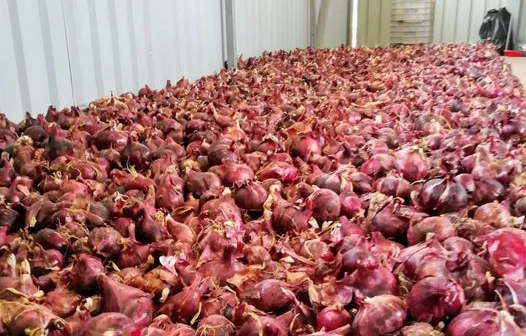
In Lanzarote, with the decline of tobacco in the years 70, Onion cultivation boomed, reaching production in the decade between 1980 y 1990 a volume of 25 million kilos.
In the cultivation of onion, the chive system was initially used, consisting of making a seedbed to obtain the plant and from there the transplant to the seedbed, and later with garlic.
Cultivation in sandy areas allows humidity to be retained and fill in water shortages with some support irrigation as long as the rainfall that year is low..
The onion itself Lanzarote presents medium size, a globose shape and white flesh; slightly sweet. and soft is grown mainly in the central area of the Island and is basically intended for domestic consumption and export to the rest of the Canary Islands, where it is highly appreciated, like to the Peninsula.
And even if it makes you cry in the kitchen, It has become an essential ingredient in gastronomy. It cannot be missing in your stir-fries, stews, soups or salads, providing flavor, texture and endless beneficial properties.
Where there is onion there is history and tears.
Cover photo: Jaime Caballero Díaz/memoriadelanzarote.com