


|
Listen to this article now
Getting your Trinity Audio player ready...
|
GF Hotels obtains zero waste certification from AENOR after reducing the kitchen by one 60% the discarded food at their buffets
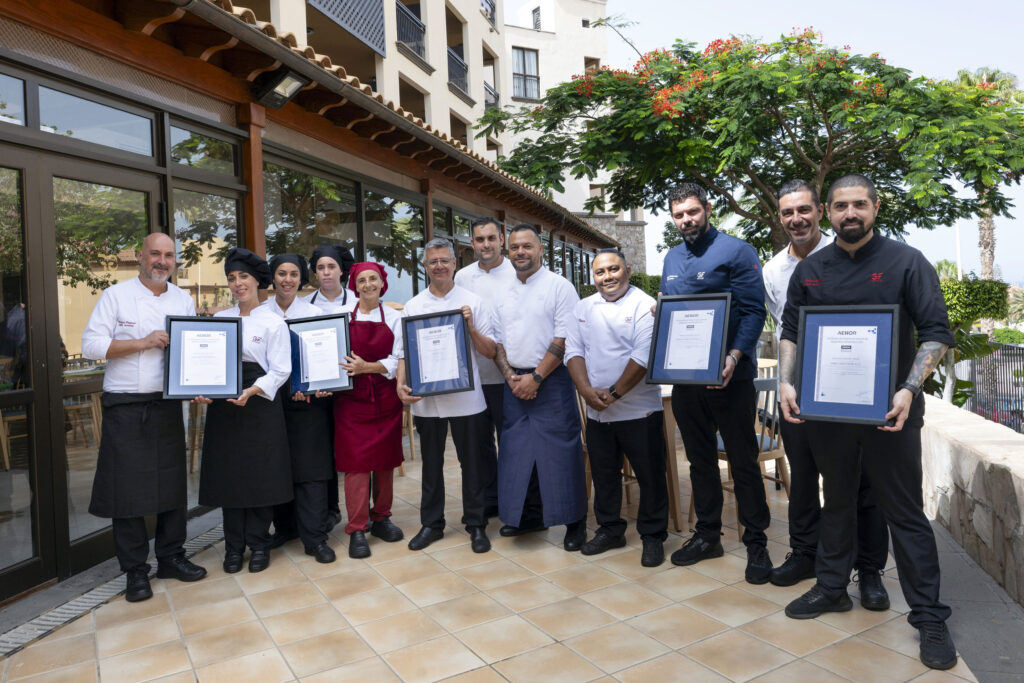
>>>GF Hoteles has obtained the certification of Zero Food Waste Management System of AENOR for its five hotel establishments. The recognition supports a sustainability strategy that, beyond environmental discourse, enters directly into one of the most sensitive points of hotel gastronomy: the large volume kitchen, planning the pantry and actually controlling what ends up in the bin.
The certification comes after the implementation of Food Waste, a predictive production system based on artificial intelligence that allows you to accurately measure what food is discarded in each service. The tool identifies leftover products, It weighs them and uploads that information into a database managed by the kitchen teams themselves.. From there, the head chef can adjust purchases, production and mise en place with a much more accurate photograph of what happens in each buffet.
The gastronomic interest of the project is precisely there. in a hotel, cooking well is not just about offering variety, abundance and attractive dishes throughout the service. It also requires rigorous calculation, read customer behavior and prevent overproduction from becoming an assumed routine. On that ground, technology allows the chef's intuition to be supported by data: what is consumed more, what's left, what time of year, with what guest profile and in what type of service.
According to GF Hotels, the system began to be applied in the hotel GF Gran Costa Adeje and it already works throughout the chain. Its implementation has allowed us to reduce food waste by 60%, avoiding more than 1.000 kilos of food thrown away per month per buffet, as Víctor Escobar explains, responsible for sustainability of the company.
The measure also changes the way of understanding the buffet. Against the old logic of filling trays until the last minute, predictive management forces cooking with more precision, replenish more judiciously and adapt production to real demand. The goal is not to impoverish the customer experience, but make it smarter: maintain quality, variety and feeling of abundance without making surplus an inevitable part of the model.
The strategy is completed with the participation of GF hotels located in Costa Adeje in the project of Circular Tourist Communities, promoted by Ashotel and ASAGA Canarias. Through a separate door-to-door collection system and own containers, biowaste from kitchens and green areas—fruit and vegetable peels, egg shells, coffee grounds or pruning remains—are used to produce quality compost.
This circuit returns to the land part of what was previously lost in ordinary waste management.. for the kitchen, means closing the cycle better: comprar, elaborate, serve, measure, correct and recover organic matter for agricultural uses. Sustainability thus ceases to be a generic label and becomes a daily practice linked to the pantry., to the product and the internal work of the teams.
From AENOR, Javier Lantigua Gaztañaga, director of the Canary Islands headquarters, Middle East and Africa, emphasizes that this certification accredits the implementation of processes to prevent, measure and manage food waste systematically. In the case of GF Hotels, The recognition highlights a strategy based on continuous improvement, the optimization of resources and the integration of sustainable practices in daily activity.
with this seal, GF Hotels reinforces a model where hotel gastronomy also begins to be measured by its invisible efficiency. Good cuisine is not only in what reaches the plate, but in everything that happens before and after: the purchase, the calculation, the use, team training and the responsibility of not turning perfectly useful food into waste.

