


|
Listen to this article now
Getting your Trinity Audio player ready...
|
thirty years ago, Spanish cuisine amazed the world and in its 23rd edition Madrid Fusion analyzes the reasons and motives that articulated that revolution
thirty years ago, Spanish cuisine amazed the world and in its 23rd edition Madrid Fusion Foods from Spain 2025 wants to analyze the reasons and motives that articulated that revolution that radiated throughout the planet from 1995 and that moved the world gastronomic epicenter here. That's why, the most important gastronomic summit in the world, that will be celebrated 27, 28 y 29 January in the Pavilion 14.0 y 14.1 by Ifema, will have as its motto 'Revolutionaries’. creative freedom, the will to change, the rebellion, the daring to change the rules or the generosity to share advances and discoveries are some of the innovations that those revolutionaries introduced in avant-garde cuisine and that during Madrid Fusion Foods from Spain They will be remembered hand in hand with their main protagonists and many others who continued to be part of that movement or who now continue to carry that banner..
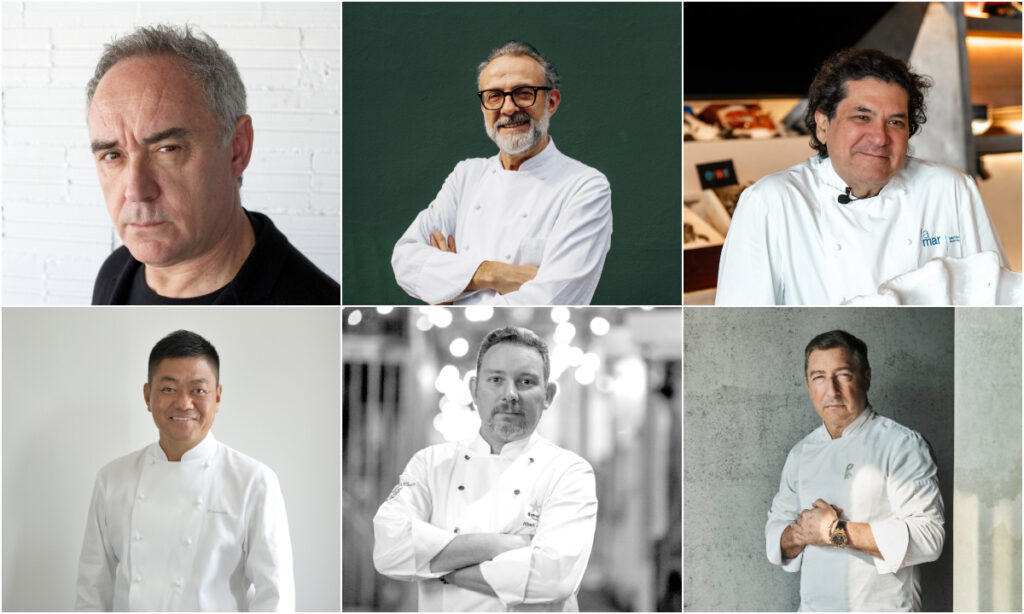
It will be much more than a tribute to the chefs who at the end of the 20th century and the beginning of the 21st changed the direction of cooking in the world.. A creative movement that still affects many young chefs and has international recognition. Spanish cuisine underwent an authentic transformation led by chefs such as Ferran Adrià and his brother Albert, Juan Mari Arzak, Pedro Subijana, Andoni Luis Aduriz, Dani Garcia, Quique Dacosta, Joan Roca, Carme Ruscalleda o Martin Berasategui.
Changed the way of thinking and working
That was the most influential movement in the world of gastronomy of New Cuisine, and had an impact on the way of thinking and working of chefs on the five continents.. That catharsis in the kitchen changed the mental structure of the chef when cooking and the diner when tasting, due to the arrival of the tasting menu. Knowledge began to be shared, Chefs stopped being dogmatic and a new path was shown to the world in which cooking was understood as a language.. Kitchens were created that have changed the paradigm when it comes to working, workshops and labs where you work as a team. Y new tools or new uses appeared: blender, siphon, silicone molds, gastrovac, rotation, freeze dryer, runner, paco jet, etc.
The enormous creative capacity caused non-existent styles to be created: minimalism, deconstruction, symbiosis of the sweet world with the salty world or trompe l'oeil. Y new techniques and elaborations: ice creams and salty sorbets, new soups, sauces, jellies, frozen powders, aires, foams, clouds, pomp, cooking with liquid nitrogen, distillates, spherifications, obulate techniques, smoked at the moment, blown sugar, edible papers, marine sausages, new saltings, new fermentations, etc.
That revolution also left interdisciplinary relationships as a legacy. Chefs began working with tableware designers, They opened up to dialogue with science, with art or with excellent education, even going so far as to 'conquer'’ Harvard with the appointment of an honorary doctor of a chef for the first time in history, Ferran Adrià.
Dialogue with Japan and Latin America
The cultural exchange with other continents gave way to a dialogue with Japanese gastronomy and another with Latin American gastronomy.. And they began to look at the product in a different way., to give the same value to everyone regardless of their price and to focus on the search for the purity of the product's gene.
New processed and unprocessed products and others that had not previously been used in haute cuisine also arrived.. In kitchens, we began to look for contrasts in temperatures and textures., to separate the concept of main product and garnish, to create new cocktails from food techniques and to generate new alcoholic and non-alcoholic drinks.
The structure of the menus was also altered by this revolution. The tasting menu that we now know as long and narrow with multiple passes was created and new concepts appeared in the gastronomic experience: creative cocktail, new snacks-tapas, prepostres, morphings…
The revolution in the room
The revolution that began 30 years also came to the room, Rigidity was eliminated with the appearance of informality in the service and the creation of a new vision of “cook in the living room”. The customer experience has also changed., by going from passive to active actor who goes to the restaurant to have fun, when the provocation is incorporated into the experience, sense of humor or irony. This new way of understanding cooking also introduced the sensuality associated with eating certain dishes with your hands., something unbecoming of haute cuisine. In most of these restaurants, the menu disappeared from the diner's offer., bread and cheese carts. And the finger food, the tendency to eat large dishes in small doses, became common in haute cuisine.
Those wonderful years also caused Spanish chefs to become characters who received recognition from the large international general media.. Ferran Adrià appeared on the cover of The New York Times (2003) and then in the Le Monde supplement (2004). His work began to transcend gastronomic publications.
Three decades later, The impact of this revolution on Spanish cuisine and the rest of the world is enormous.. In Spain, in these 30 years has multiplied the recognition of gastronomic excellence and three restaurants with three Michelin stars in 1994 has gone to sixteen in 2024. New steakhouses have appeared that are considered the best in the world, signature seafood restaurants and countless gastronomic restaurants. And a shower of first places in all the world rankings, starting with The World list 50 Best Restaurants, where Spanish restaurants have occupied the first places for the last 20 years. This revolution in Spanish cuisine not only changed the way we understand gastronomy, but it has also had a significant economic and cultural impact. Spanish cuisine became a tourist attraction, and cities like Barcelona, Madrid, San Sebastián and Girona began to be recognized as first-rate gastronomic destinations.

