


|
Listen to this article now
Getting your Trinity Audio player ready...
|
Agaete coffee consolidates its uniqueness with microproduction, sustainable cultivation, experiential tourism and an identity linked to the valley
In the northwest of Gran Canaria, he Agaete coffee has ceased to be just an agricultural rarity to become consolidated as one of the most unique gastronomic products in Canary Islands. Its exceptional cultivation status in Europa, Its limited production and its strong connection with the landscape have made the Agaete Valley in a coffee-growing territory with its own story, able to unite agriculture, sustainability, tourism and haute cuisine.
With family farms that in some cases have nearly two centuries of history, Agaetense coffee maintains a small-scale production model, based on traditional techniques, manual harvesting and meticulous dedication per plant. Its annual production, that is barely around 5.000 kilos depending on weather conditions, places it at the opposite end of the large exporting countries. Agaete does not compete by volume: compete for identity, exclusivity and territory.
A crop off the map
The first singularity of coffee Agaete is in its location. It grows outside the usual tropical belt, in a valley of volcanic origin where moderate altitudes converge, atlantic humidity, fertile soils and natural protection against certain air currents. This combination allows the coffee tree to find Gran Canaria unusual conditions to develop.
The cultivation is organized in small family farms, many of them under shade and in polyculture. Coffee trees coexist with banana trees, citrus, avocado trees, mangos, papayas and other fruit trees, forming an agroforestry system that helps conserve humidity, reduces soil evaporation and promotes biodiversity.
This model, more than a fashion linked to sustainability, responds to a historical way of working the land. The shade of the fruit trees and the cliffs of the valley favor slower ripening of the fruit, which contributes to a higher concentration of sugars and aromatic compounds in the grain.
The hand that collects the coffee
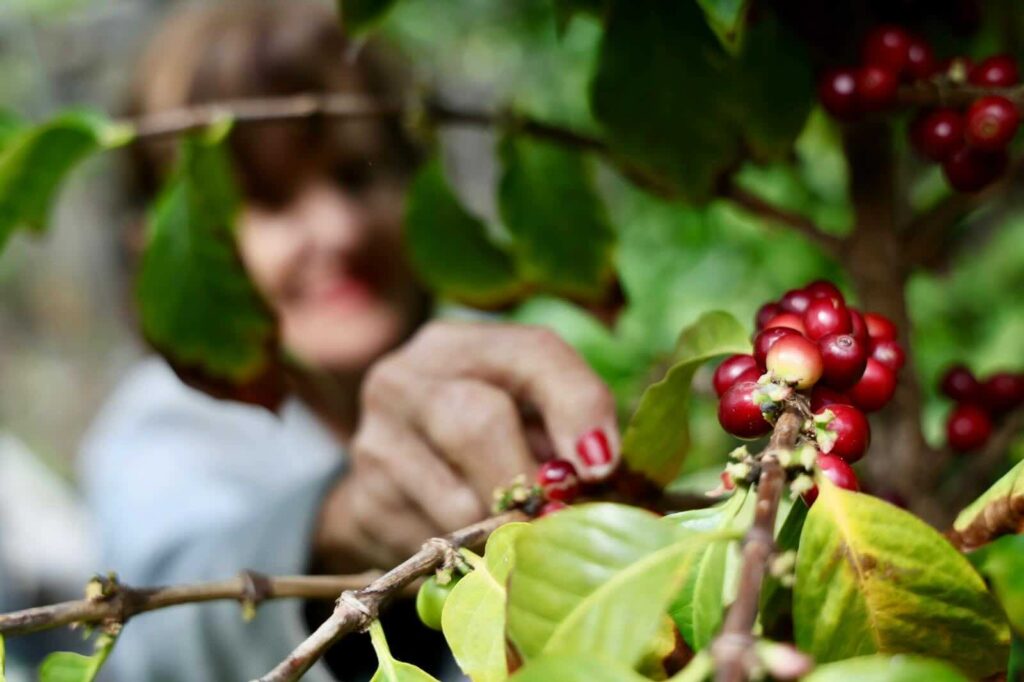
The quality of coffee Agaete starts at harvest. The cherries are picked by hand, one by one, only when they reach the optimal ripening point. This work has historically been closely linked to the women of the valley, transmitters of knowledge and silent protagonists of an agricultural culture that now seeks greater recognition.
The subsequent process also maintains a logic of minimal intervention. Natural drying in the sun, Respectful technology and family scale allow the character of the grain to be preserved without breaking the balance of the environment.. Traditionally, even pulping was done with stones, a sample of the artisanal component that has accompanied this island coffee farming for generations.
The result is a coffee with a balanced profile, with low acidity, silky texture and notes that may remind you of cocoa, the ripe fruit, cinnamon or sweet nuances, depending on the farm, drying and roasting. in the cup, Agaete expresses both its microclimate and the care of each producer.
Sustainability before being a trend
The coffee of Agaete It is also an example of practical sustainability. Many farms reduce the use of chemical inputs, They use organic fertilization and conserve volcanic soils through plant cover. The integration of cultivation into the traditional agricultural landscape contributes, besides, to stop erosion in sloping areas and to keep alive a productive ecosystem adapted to the territory.
Its low water footprint compared to intensive models and coexistence with other crops reinforce its environmental value. In a context marked by climate change, this shade coffee, family and small scale can become an added strength for the future of the valley.
From the farm to the tourist cup
The marketing of coffee Agaete relies on direct sales, specialized points and tourism linked to agricultural products. What for years may have seemed like a limitation—its low production—has become a differential value.. It is a high-end coffee, sought after by professionals and amateurs, with presence in markets such as Japan, USA, Germany or the United Kingdom.
But its greatest power is perhaps in experience. Farms like La Laja, The Chestnut Trees o Platinum Coffee have opened their doors to visitors with guided routes that allow them to learn about the process from the plant to the cup. The tour includes observation of the crop, the collection, drying, the pulping, the toast, grinding and tasting.
In some farms they receive up to 250 daily visitors of around twenty nationalities. The café thus becomes a gateway to the rural landscape of Gran Canaria, to its fruits, Wines, artisan sweets and traditional products. Not just a drink is sold: a story is sold, an agricultural culture and way of life.
A product with its own moment
Specialists like Antonio Marquez e Ivan Perez agree that Agaete coffee is going through a particularly favorable moment. The rise of specialty coffee, interest in original products and the search for authentic gastronomic experiences play in favor of a crop that brings together all these attributes.
Its strength is not only in the organoleptic quality, but in the whole: history, tradition, landscape, limited production and emotional bond with the territory. In a market increasingly attentive to origin, Agaete has something difficult to replicate: a European coffee, Atlantic, artisanal and connected with a very specific island identity.
He Agaete Coffee Valorization Program, led by Agroagaete and supported by HELP Gran Canaria within the Umbrella Project, seeks to reinforce precisely that knowledge inside and outside the Archipelago. The initiative also vindicates the role of women in the sector and the need to protect a coffee culture that is part of the agricultural heritage of the Canary Islands..
Agaete's coffee no longer needs to be explained as a curiosity. Today it is presented as a micro-produced gastronomic jewel, a sustainable tourist resource and a living expression of the territory. In every cup there is shadow, volcano, atlantic humidity, family work and rural memory.

