


|
Listen to this article now
Getting your Trinity Audio player ready...
|
More than 400 hospitality establishments in Gran Canaria join the Hospitality campaign #PorElClima
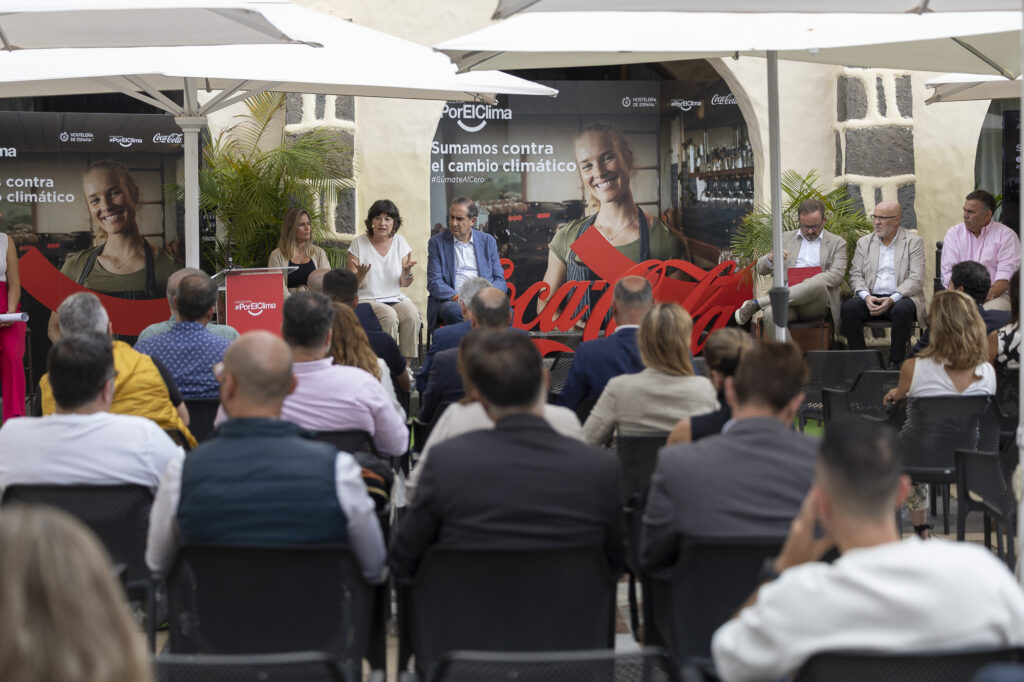
Coca-cola, ECODES, Hospitality of Spain, Gran Canaria Chamber of Commerce, The Government of the Canary Islands and the Cabildo de Gran Canaria today presented the hospitality initiative #Porelclima, an activity against climate change to which they have joined 421 hospitality establishments throughout the province that join the others more than 15.000 bars and restaurants in the country adhering to this proposal.
The event was attended by the Deputy Minister of Industry, Commerce and Consumption of the Government of the Canary Islands, Felipe Afonso El Jaber; the Minister of the Environment Area, Climate, Energy and Knowledge of the Cabildo de Gran Canaria, Raul Garcia Brink; Public Affairs Manager, Communication and Sustainability of Coca-Cola Europacific Partners Iberia South Area, Beatriz Codes; the president of the Domestic Trade Commission of the Chamber of Commerce of Gran Canaria, Eugenio Sanchez; the director of Hospitality #PorElClima of ECODES, Ana Mastral; and the manager of Casa Romántica Restaurant, Victor Lugo.
The Public Affairs Manager, Communication and Sustainability of Coca-Cola Europacific Partners Iberia South Area, Beatriz Codes, He stated in his speech that “for responsibility, by impact and capacity for action, Companies have an essential role in the fight against climate change. With the impetus of this platform, aimed at the hospitality sector, Our challenge is to join forces in this fight through alliances, as established by the Sustainable Development Goal 17 of the United Nations and which is fundamental in this project”.
The director of Hospitality #PorElClima of ECODES, Ana Mastral, stated for his part that “Hospitality #PorElClima highlights the prominence of bars and restaurants to descend into everyday life, to concrete action, the ambitious goal of the Paris Agreement. We have seen how the global agenda is growing and accelerating the implementation of measures so that the increase in the planet's temperature does not exceed the 1,5 °C at the end of the century. And hospitality companies are fundamental in this action because they are taking responsibility for their CO₂ emissions, having the opportunity to become models for other establishments., and for citizens in the streets, in the neighborhoods and municipalities in which they are established”.
The Deputy Minister of Industry, Commerce and Consumption of the Government of the Canary Islands, Felipe Afonso El Jaber declared that “The Canarian industry is committed to sustainability, This commitment is general and involves the territory, the community, society and the entire island economy”. Besides, highlighted the hospitality industry as “great example for its impact on society”. “They show that this divorce between sustainability and economy is not always true, both can go hand in hand”, pointed out.
“The hospitality sector can and should be an engine of change. Bet on local products, reduce food waste, Improving energy efficiency or minimizing waste not only improves business competitiveness, but it contributes directly to the sustainability of the territory”, stated the Minister of the Environment Area, Climate, Energy and Knowledge of the Cabildo de Gran Canaria, Raul Garcia Brink.
From the Casa Romántica Restaurant, Victor Lugo, He stated that the way his business works “It means defending the local product, taking care of the temporality of the menu and providing value to our team and the area”. “We are clear that we want to continue with a sustainable system, one that goes hand in hand with producers, artisans and companies like Coca-Cola, who defend and support this type of initiatives.”.
The event was closed by Eugenio Sánchez, president of the Domestic Trade Commission of the Chamber of Commerce of Gran Canaria. “In recent years, We have seen how bars and restaurants throughout Spain and also here in the Canary Islands have implemented actions that not only benefit the environment., but also reinforce the competitiveness of businesses, which shows that they are compatible with excellence in service and profitability. Innova GastroCan and the Gran Canaria Chamber of Commerce are fully committed to this transformation process”, stressed.
They have joined the #PorElClima Hospitality initiative in Las Palmas 421 establishments in the province of Las Palmas. Among those adhered, There are businesses on the Island of Fuerteventura, of the municipalities of Antigua, Bird, Betancuria, Casillas del Ángel, Caleta de Fuste Castle, Corralejo, Costa Calma, El Cotillo, Great Tarajal, Lajares, La Lajita, The Olive, Bare Plains, Morro Jable, Puerto del Rosario, Tarajalejo and Tetir; of the Island of Gran Canaria the towns of Agaete, Agüimes, Arguineguin, Arucas, Firg, Galdar, Wit, The Village of San Nicolás, Las Palmas de Gran Canaria, Maspalomas, Melonized, Mogan, Moya, English Beach, Port of Taliarte, Puerto Rico of Gran Canaria, San Bartolome de Tirajana, San Fernando de Maspalomas, Santa Lucía de Tirajana, Santa María de Guía de Gran Canaria, Counted, and Vega de San Mateo; and the Island of Lanzarote of Arrecife, I would do, White beach, Puerto del Carmen, San Bartolomé, Teguise and Tías.
The owners and managers of these establishments have answered a questionnaire 28 questions about saving water, energy efficiency, sustainable mobility, the carbon footprint, responsible consumption and correct waste management, which has allowed the study of personalized measures for each of them to act against climate change.: in total 3.796 measures put in place on water saving issues, energy efficiency, sustainable mobility, responsible consumption, carbon footprint and waste management.
Among the conclusions of these audits, The following data stands out:
– In Gran Canaria the 84% establishments have flow reducers placed on all their taps. This represents a great saving of water, since flow reducers reduce your water consumption up to a 50%.
– He 99% of establishments collaborate with the reuse of glass. Besides, he 100% of establishments carry out glass recycling. For every glass bottle that is recycled, saves the energy necessary to have a television on during 3 hours.
– He 99% of establishments use LED lights for room lighting, cocina, terraces or warehouse of Aranese establishments, allows savings in consumption and, therefore, of economic cost and emission of greenhouse gases that can reach up to 90% regarding incandescent bulbs.
– He 28% of establishments have electric vehicle charging points available to customers. Transport is the main greenhouse gas emitting sector in Spain. It is time to bet on electric mobility, much less polluting, that little by little is gaining space. To do this, it is necessary to support it by placing charging points for its operation..
– He 74% of establishments use products made from recycled materials, The consumption of this type of products has a lower impact on the environment, since they generate less CO₂ emissions as they require less energy for their manufacturing.
– He 100% of establishments work with local suppliers. Prioritizing suppliers as close as possible reduces CO₂ emissions derived from transportation to the food establishment, thus avoiding manipulation of the product, and greater packaging.
Hospitality #PorElClima guides, on its path to decarbonization, to each member through the climate profile of their establishment on the project website hosteleriaporelclima.es.

