


|
Listen to this article now
Getting your Trinity Audio player ready...
|
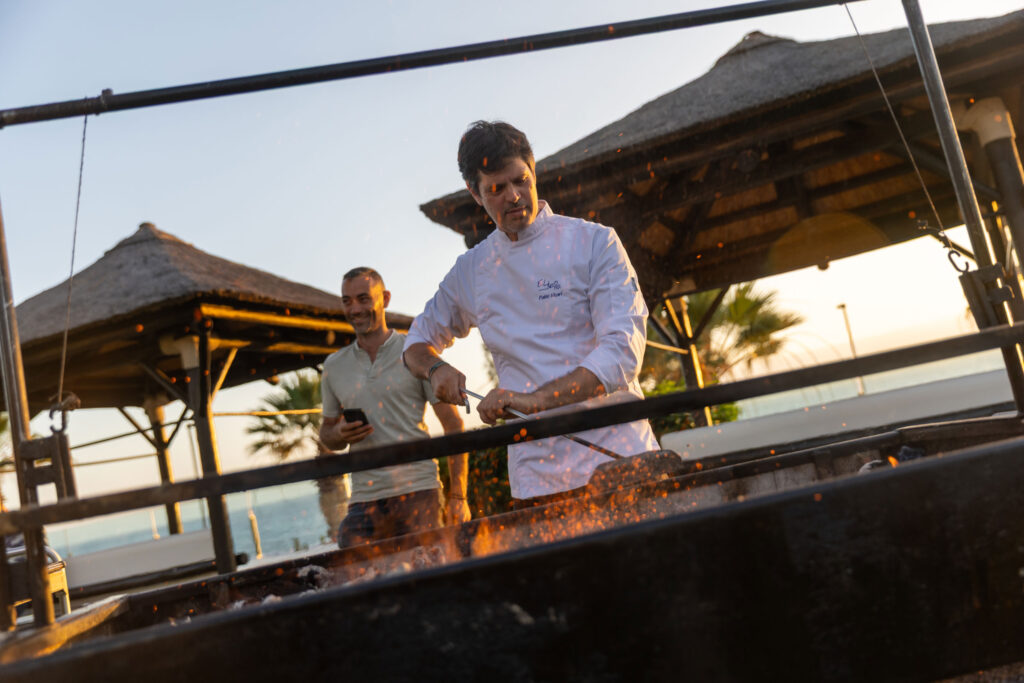
Aitor Arregi, accompanied by Pablo Vicari, demonstrates that “The nudity of the grill is the best tribute to a product that speaks of territory”
The seventh edition of the seas meeting started -which intends to value salt as an essential component of the oceans and ingredient, symbol and cultural link between humans and the sea- with a unanimous declaration by all participants in this event: the need for “continue studying and investing in the marine world”. A statement repeated by many on the opening day of this event, promoted by the Cabildo of Tenerife, through the areas of Tourism and Primary Sector and organized by Vocento Gastronomía, and that took place right on the beach at Bahía Beach, from Arona (Tenerife). And in the same way that the ocean and the land join hands on the coast of this Canary Island, Benjamin Wool, general director of Vocento Gastronomy, has recalled that Meeting of the Seas also promotes that “communion between science and gastronomy together with a responsible fishing sector”, a synergy that during the seven editions of the congress has shown that in the same way as “cooking needs real knowledge, Science can take advantage of someone who helps its voice be heard further and that role can be played perfectly by gastronomy., the influence of which now transcends outside the sector itself”.
It coincided with this vision of teamwork, the CEO of Tourism of Tenerife, Dimple Map, who added that “This event reflects our commitment to a sustainable tourism model, where the sea, Cuisine and our traditions intertwine to offer authentic experiences that enrich both those who visit us and our local communities.”.
Precisely with the story of a new unique experience by the Cádiz chef Angel León (Aponiente***, Port of Santa Maria) the morning has begun. The man known as the chef of the sea has presented his new construction project “of an estuary 3.0 never seen before, with channels 5 meters deep” that cause more currents and favor the proliferation of more species in the 20 acres of marsh that surround your restaurant. “We have had the concession for seven months”, the cook explained, “and finally we will be able to develop ideas such as the cultivation of seagrass or sea soybeans”. “Recovering this marsh is a project that takes me out of my comfort zone”, León was sincere, “because I felt that I was in a boring moment and the marsh has given me back my hope”. So that Aponiente customers can walk through this estuary there are still three weeks of work left., and their intention is to shoot it well from October to February, so that in March it is at full capacity.
From latitude 36 3 of the Cadiz estuaries, Meeting of the Seas has spoken of twinning with the waters of the latitude 43 2. Cadiz and Guipúzcoa. Cataria and Elkano. Pablo Vicari y Aitor Arregi. Both chefs have recounted the culinary and knowledge journey that entailed transferring Elkano's philosophy* (Guetaria) to the restaurant that both also run in Santi Petri, Cataria. “The sea unites us all”, Aitor Arregi has stated when explaining the meaning of the return journey that began with his Andalusian adventure.. The Basque assured that “although the fire is the same, the result is not” why “the dish is nothing more than the description of a territory, of inherited knowledge”, and that is marked by the environment. To which Vicari added that precisely to get to know that environment “It was necessary to find someone from the area to show us their reality”. They found that person in the Cádiz fisherman Emilio Marin, who accompanied them on stage sharing his knowledge about new products in Basque cuisine, like the nettles, moray eels or oysters. “The sailor is the first cook”, stated Aitor Arregi when he assured that it is vital to listen to what they have to say, and had the complicity of Pablo Vicari, who recognized that “Cataria would be meaningless if we couldn't learn”.
The Atlantic waters also permeate the cuisine of another of the chefs who took the stage at Meeting of the Seas today, it's about portuguese Gil Fernandes, in charge of the Fortaleza do Guincho restaurant* (Cascais). Fernandes has offered a master class on the use of seaweed in gastronomy, a product that, in your opinion, “has a lot to offer, That is why you have to explore and use creativity to build new recipes with seaweed.”. This Portuguese chef, for whom the traditional cuisine of their grandparents is the basis, advocates using “seasonal seaweed” and promote its use as a salt substitute, “seaweed is a way to use salt without using it, algae have their own salt”.
Rediscovering salt
With the scientific director of the congress, Professor of Marine Sciences at King Abdullah Kaust University of Science and Technology (Saudi Arabia) Carlos Duarte, we have learned that “salt is being rediscovered as a valuable material, just as it was in ancient times, with many applications”. His presentation focused on this renaissance of sea salt, focusing on the “multiple benefits of salt on human health, with positive effects on respiratory health, improving digestion, preventing excess cholesterol or how bathing in salty or hypersaline water is good for atopic skin”. Of all this “avalanche of interest in salt”, Duarte has also highlighted other uses such as energy storage., power grid stabilizer; or other emerging uses of salt to improve the hydrogen production process or the extraction of lithium from seawater, an important metal in the energy transition.
Meeting of the Seas has continued to delve into its more scientific aspect with the presence of Xabier Irigoien, research professor at Ikerbasque, who has taken the audience to the depths of the ocean to learn about mesopelagic fish, those who “They live in the water column where there is light to see but not enough for algae to grow.”. Irigoien has stated that this type of fish “They are still great unknowns, we have underestimated them, We don't even know how many of them there are.”. A situation that is being tried to solve because “They play a very important role in the capture of CO2”, since these fish rise to the surface every day to feed and then go down to the depths where that CO2 is retained. It is estimated that they may be 5000 millions of tons of these fish that “every day they actively carry out this important task”, without losing sight of the fact that they could also be used to make fish meal; another important role that deserves to be valued although, for now, “With the technology we currently have it is not profitable because fishing for these small fish would involve using a lot of energy for less use.”.
He agreed with Xabier Irigoien on the need to continue studying the oceans Pedro Pascual, researcher at the Spanish Institute of Oceanography, who claimed that “tuna are still enigmatic”. Tuna have precisely been the protagonists of the day's round table in which the chef also participated Diego Schattenhofer (Taste 1973*, Aaron, Tenerife) y Enrique Lozano, PhD in Biodiversity and Conservation from the University of La Laguna. The three have exemplified how collaboration between science and gastronomy is key and have presented the results of a study carried out with tunas from the Canary Islands that demonstrates “Heavy metal concentrations in tuna have decreased since legislation passed in the 90s”. with which, “It is safer for our health to eat tuna”.
He has also spoken about the positive effect of the implementation of certain regulations Isabel Artime, General Secretary of Fisheries of the Ministry of Agriculture, Fishing and food, by defending with figures that fishing “It is an activity compatible with the conservation of the environment”. Proof of this is that last year in Spain a 13% more with fewer fishing days. “If management is effective, resources respond”, concluded.
This first day of this edition of Meeting of the Seas, a congress that has the support of Tenerife Despierta Emociones, has also heard Xavier Agote, founder and president of Albaola, who has announced that this fall a replica of the transoceanic galleon San Juan, sunk in the 16th century, will be ready to set sail again.

