


|
Listen to this article now
Getting your Trinity Audio player ready...
|
Meeting of the Seas closed in Tenerife with a call to protect the ocean, Cook more fresh fish and recover your consumption at home
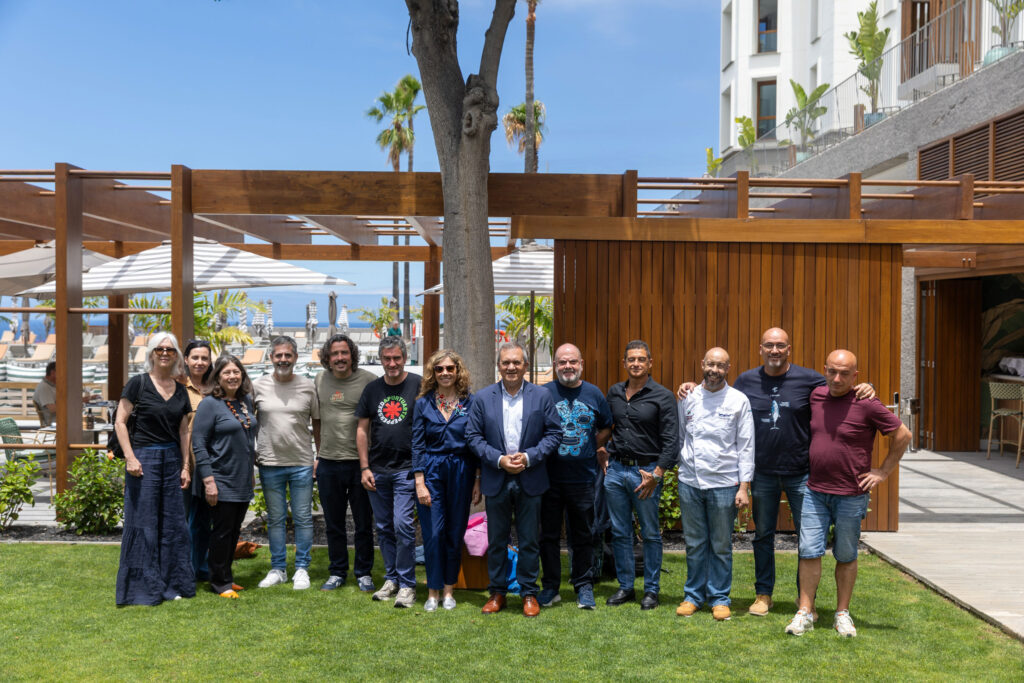
The VIII edition of Meeting of the Seas three days of dialogue between science closed in Tenerife, gastronomy and fishing sector with a clear message: “The sea is worth much more alive than dead”. The phrase, delivered at the closing by Benjamin Wool, director of Vocento Gastronomía and promoter of the congress, summarized the spirit of an event that once again placed the ocean at the center of the food debate.
During the meeting, chefs, Researchers and professionals linked to the sea defended that the future of food depends on the health of marine ecosystems and the ability of gastronomy to connect the consumer with those who live and work in the ocean.. The kitchen thus appeared not only as a creative space, but as a tool of awareness, education and transformation.
One of the most powerful messages came from the hand of María Luisa Álvarez Blanco, general director of Fedepesca, the National Federation of Provincial Associations of Fish Retailers in Spain. Álvarez warned of the continued decline in fish consumption in Spain, what has happened from 24,6 kilos per person in 2014 a 17,99 kilos in 2025, an evolution that he described as worrying from a health point of view.
The head of Fedepesca focused especially on homes with children, where fish consumption is lower, and pointed out the loss of the habit of cooking at home as one of the big problems. As explained, more than eight million people, he 41% of the population, never cooks.
Álvarez also demanded a change in the discourse on the price of fish. He defended that they insist on presenting it as an expensive product, when its evolution is below the CPI, and recalled that artisanal fishmongers offer more and more services to facilitate consumption: boneless fish, ready to cook product, home department, elaborate and experiences.
In that line, requested the elimination of VAT on fish as a measure to encourage its consumption. In your opinion, Applying zero VAT to a healthy food would also mean health savings. “There is a fish for every palate and every pocket”, defended, facing the advance of ultra-processed.
Gastronomy as a speaker for the fishing sector was another of the axes of the day. Eduardo Guardiola, general director of the Sevillian group The Mooring, which integrates projects such as Tribeca and Cañabota, defended the value of working with seasonal fish. As explained, not only does it offer more quality and better price, but it allows us to tell the story of the dish and the fisherman.
Guardiola insisted on the need to give visibility and fair treatment to the marine producer. For the businessman, Small changes in the price paid to the fisherman can make the difference between abandoning the profession and the possibility of new generations continuing to be linked to the sea..
The emotional relationship between territory, cuisine and product also had prominence with the conversation between Miguel Barrera, head of Cal Paradise, in Castellón, y Alberto González Margallo, of San Sebastian 57, in Santa Cruz de Tenerife. Barrera defended a cuisine that comes from the nearby landscape, between mountain, truffle, Mediterranean mushrooms and fish, while González Margallo defined his proposal as “the love between a peasant and a mermaid”, uniting coast and interior from culinary memory.
The scientific perspective reinforced the message of urgency. Ester Serrão, professor at the University of the Algarve and researcher at CCMAR, underlined the ecological and economic value of underwater forests, seagrasses and macroalgae, essential for storing carbon, protect coasts and sustain fishing. warned, besides, that when an ecosystem collapses its recovery can take up to 300 years.
From the Canary Islands, the professor Santiago Hernandez Leon, director of the Institute of Oceanography and Global Change of the University of Las Palmas de Gran Canaria, claimed the role of the archipelago as a great blue treasure. He warned of the pressure that their ecosystems endure due to overfishing, mass tourism and certain aquaculture practices, and asked chefs to help make less valued species attractive to incorporate them into human consumption..
The researcher Ana Gago-Martínez, from the University of Vigo, addressed the emerging risk of ciguatera in the Canary Islands, a poisoning associated with the consumption of fish contaminated with marine toxins. The expert recalled that the increase in sea temperature and changes in ecosystems favor its expansion, although he insisted on the need to communicate without alarming: we must educate the population, but keep eating fish.
The institutional closure was carried out by Valentin Esteban Gonzalez, CEO of the Primary Sector and Animal Welfare of the Cabildo de Tenerife, who defended the need to leave the sea in a better state than it is received. For this, demanded to stop seeing it only as a landscape or pantry and begin to understand it as capital natural azul.
With this closure, Meeting of the Seas once again reaffirmed its role as a reference forum to think about the future of food from the ocean. The conclusion was resounding: Protecting the sea is not just an environmental issue, but also gastronomic, economic, health and cultural.

